
As many as a dozen or so colleges and universities have returned to requiring the SAT or ACT for admission to the first-year class, after almost the entire country went to a test-optional admissions approach in response to COVID, when testing opportunities dropped dramatically. Should you?
That depends.
First, you probably know that imitation as a form of flattery is very common in higher education. I remember as a young admission officer hearing a colleague talking about the agony of reading applications during review. I looked up her college in Barron’s (pre-Internet) and found out they admitted 90% of applicants. There’s agony, and then there’s agony.
And you probably know that the big victory for ETS and The College Board was when Berkeley adopted the SAT as an admission requirement, due to lobbying pressure from an office opened near the Berkeley campus, and a desire to be taken as seriously as the prestigious universities on east coast.
Keeping up appearances, you know.
Most of the justification for going back to the SAT appears–in my opinion–to be manufactured out of whole cloth. That, or–again, in my opinion–the colleges are not forthcoming with all the data. At the very least, they’re guilty of not accounting for the disparate effects of COVID on different populations of students, including those most likely to be forced to apply test optional.
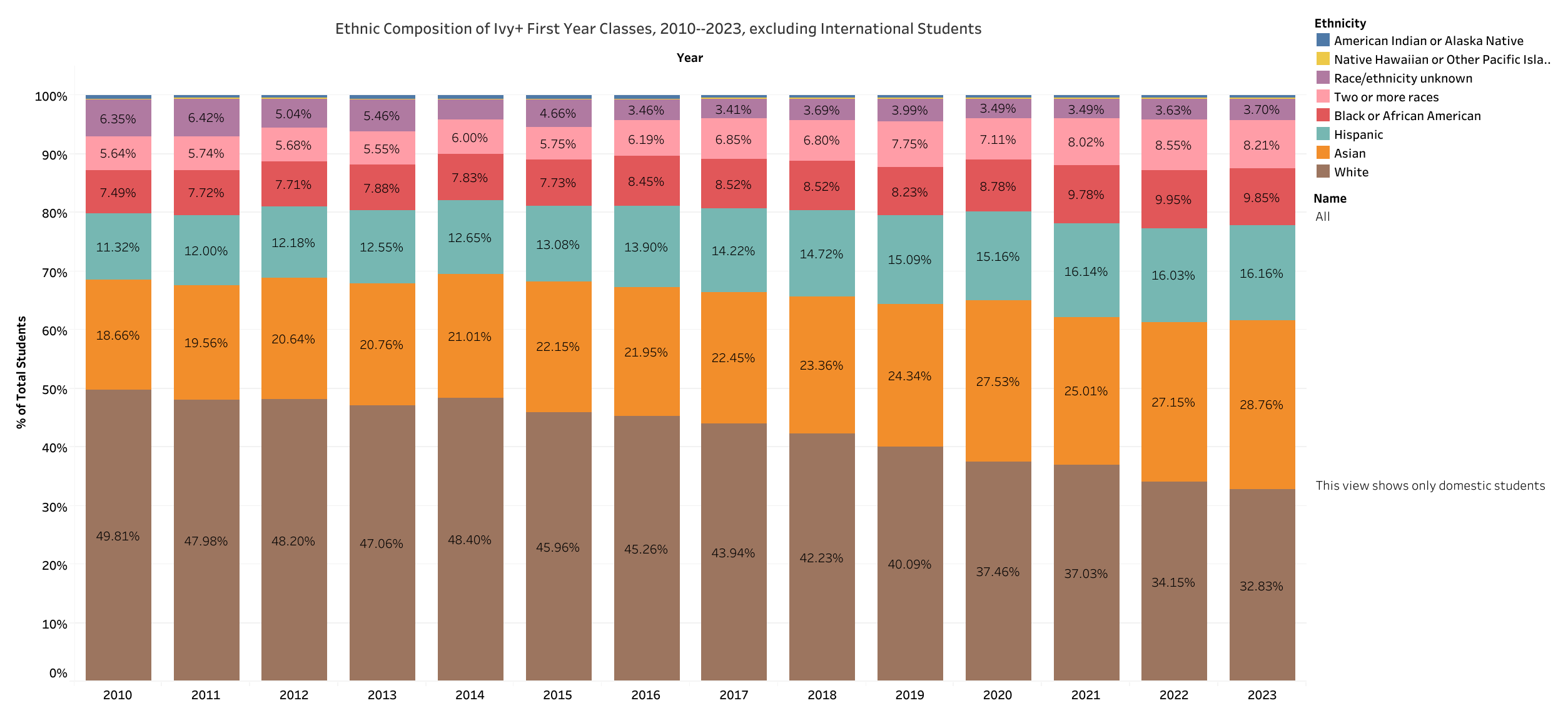
The most common justification–that they just cannot find or identify students of color without the SAT–is not just a common College Board trope, but it’s also a circular argument. What’s even more telling is that it doesn’t seem supported by the data. This shows the ethnic composition of the first-year classes in the “Ivy Plus” (The Ivy Leagues plus Stanford, MIT, Chicago, and Duke) over time. The entering class of 2021 was the first mass test optional year. (Click the image to enlarge).
So what’s the answer? Do what’s right for your institution, based on your mission and your own research. If standardized tests are right for you, and if they work, you’d be foolish not to reinstate them. If they’re superfluous, or if you think they actually work against you, it would be less than prudent to add them back to your requirements.
No matter what the neighbors might think.
Discover more from Enrollment VP
Subscribe to get the latest posts sent to your email.
 Enrollment VP