
If we were starting the college admissions process today, no one would design it the way it is. There is a lot wrong with the process of obtaining something that many of us believe to be a public good, and while I’ve written thousands of words about the other problems, the worst part is almost certainly the pricing structure.
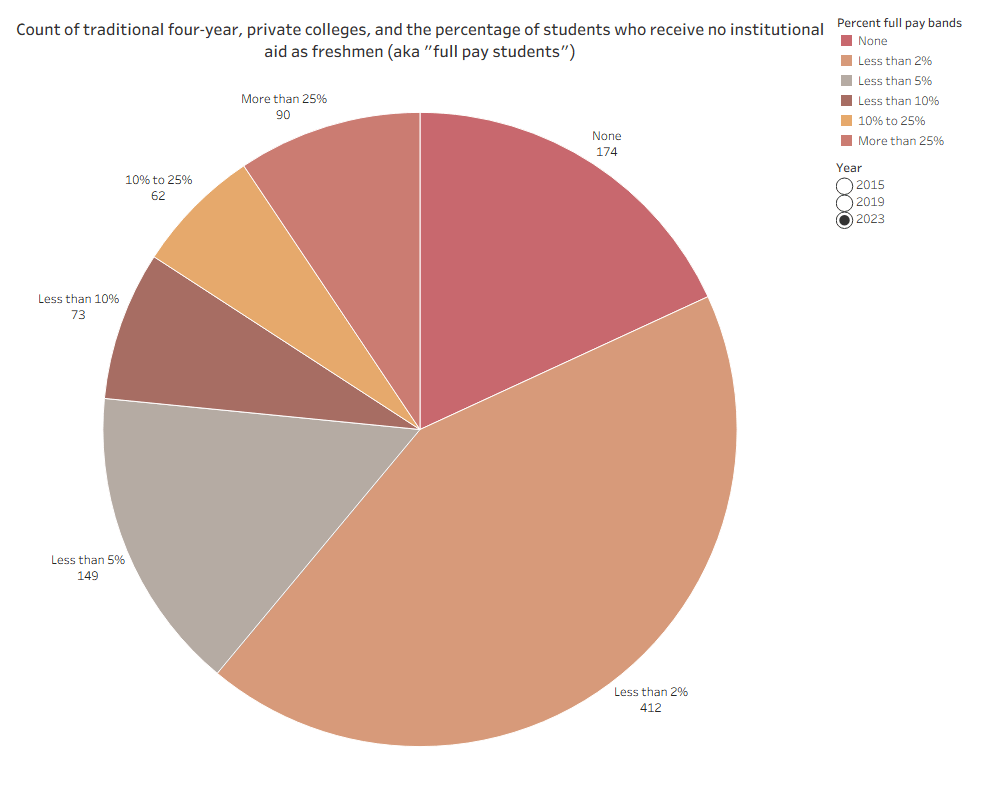
There are two issues: One is that students and parents don’t know the price until after they go through the process to apply for admission. The second is that almost no one (at least at private colleges) pays the actual published sticker price. Using 2023 IPEDS data, and looking at just under 1,000 traditional, four-year private colleges, 174 award some institutional grant aid to every first-year student. Another 561 award institutional aid to at least 95% of those freshmen.
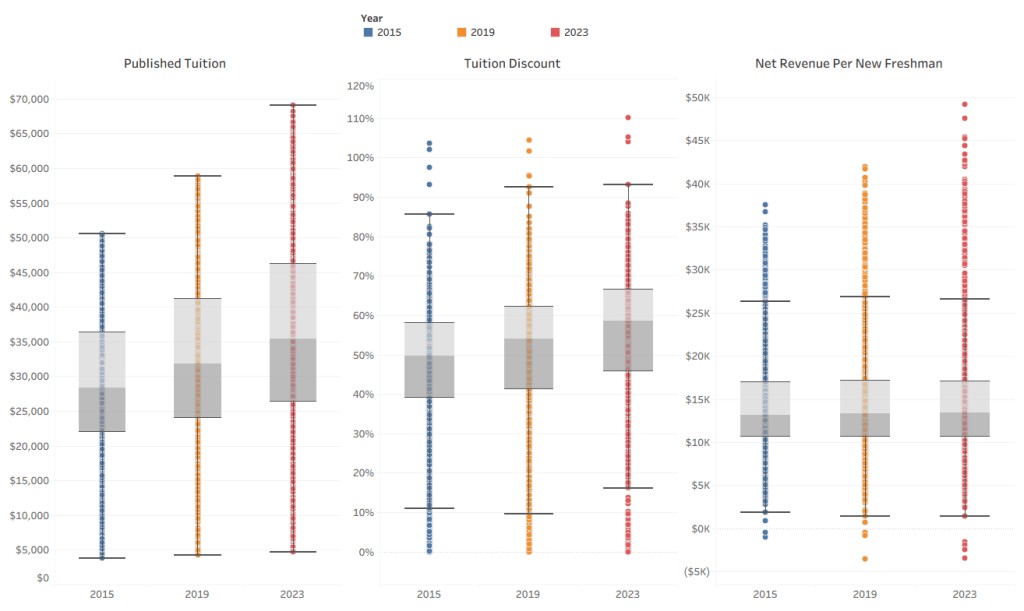
The unweighted median discount rate in 2023 (the center of the gray bar, on the middle chart) was 59%. (If your institution is at that 59% mark, and your tuition is $40,000 per year, you give every student, on average, an institutional award of $23,600, leaving you about $16,400 in net revenue.)
“This is insane!” critics say. They’re right. There are even consumer protection laws that might suggest colleges should not do this: That if no one pays full price, that full price is a misleading promotional tactic.
“That college should cut tuition to $16,400, and just get rid of these phony scholarships!” they scream. They’re wrong, or potentially wrong. For several reasons.
But this public outcry has gotten a lot of attention, and loud voices often generate action. There are a lot of institutions thinking about jumping off the merry-go-round of high tuition/high aid models. It seems like the logical thing to do, but if you’re in that boat right now and considering doing it, consider several things:
- First, if you cut tuition for incoming students only, your sophomore, junior, and senior students are going to expect you to cut it for them. You’ll assume they’ll figure out that their package of $40,000 minus $23,600 leaving them a net cost of $16,400 evens out with the new cost tuition of $16,400. I think you’d be wrong. Most people (trust me, I’ve talked to a lot of them) fail to understand that that discount is unfunded, and that it’s just like a coupon at Subway for $3 off a footlong. Many will expect that the existing scholarship is now deducted from the new tuition. And who can blame them? You told them they earned it.
- Second, there is no average student. If your average award is, in fact, $23,600, you’re unlikely to find a single student with a $23,600 award. So, let’s say you decided to do the right thing by students, and give the upperclassmen the same deal: No scholarships, but the new tuition. About half of them will end up paying less. They’ll be thrilled, and none of them will come to your financial aid office and ask you to go back to the old way. But about half of them will pay more, and almost all of them will be making appointments to complain, expecting you to make it right(er). Many of these will be low-income students. You can lose money in the short term.
- Third, there are emotional and psychological benefits to “getting a scholarship,” or “getting a good deal,” or “negotiating a better price.” If you don’t believe me, ask Kohl’s and Chevrolet, or almost any company that sells things to consumers. When your product is a commodity (or there are close substitutes available), incentives prove to be powerful tools.
- Fourth, very few parents can pin down net costs, because the state, federal, and institutional financial aid polices and awards are horribly confusing, even before you consider pricing models (one college charges by credits, so taking 16 per term is 33% more than taking 12; one college charges at the threshold, with the same price for 12-16 credits, which is great until the student majors in science and needs to take 18 per term.)
- Fifth, economists would put higher education into the “Perfect Competition” category. Individual players have very little ability to effect change in the market, and, unless you’re wildly successful, you probably won’t see competitors following you.
- Sixth, students with higher academic achievement expect to pay less than their more average peers. They have been conditioned (by colleges) to think this way. As the man said, when you point a finger, there are three pointing right back at you. You are not going to be able to get rid of scholarships all together. This means that you’ll have to raise your new tuition to cover these. And if this sounds like a vicious circle, you’d be right.
- And finally, the oldest reason of all is the Chivas Regal Effect. People believe that $40,000 education discounted to $16,400 is better than a $16,400 education. In fact, that phenomenon has often been used to justify large tuition increases: We’re better than other colleges with similar tuition to us, so we should charge more. I have literally heard presidents and board of trustee members say this.
I am not saying tuition resets or cuts don’t make sense, and I’m not saying colleges shouldn’t do this. I am saying the problem is more complicated than it appears on the surface, and any college should think of these problems and others I probably missed.
I think we all probably agree that college pricing models are broken, and in serious need of fixing. How we do that, who starts the process, and how it ends up, are yet to be determined.
Discover more from Enrollment VP
Subscribe to get the latest posts sent to your email.
 Enrollment VP