
If you work at a private college, you already know things in hyper-competitive market for students are. But have you wondered why?
Here is a chart I did for a client private institution, showing where their admitted, non-enrolling first-year applicants enrolled. The orange part of the bar shows public institutions, and the blue bar shows private institutions. I bet you notice the same thing I do.
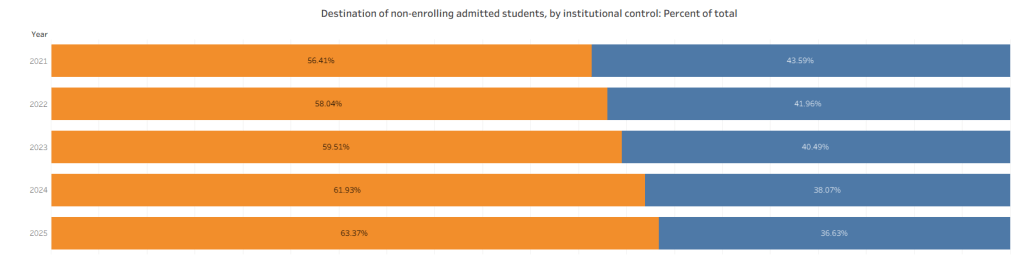
If you don’t dive deeply into your data, you might be like Peter Senge’s Boiling Frog, which is a great analogy, even though it’s not reflective of how frogs and boiling water work.
“How did we get here?” you wonder. Glad you asked.
But first, a short example: At some point, AACRAO SEM conferences, which were once the domain of private colleges, started to be dominated by bigger, public institutions as they began to embrace this thing private universities had been implementing since the 1970s, Enrollment Management. I noticed a marked change in the tone, content, and, frankly, the quality of the offerings at about the same time, and the last straw for me was a presentation by a large, regional public in the Southeast who came up with what they thought was a ground-breaking strategy in SEM: Emailing students who had not re-registered for the upcoming semester. That was it: A whole 45-minute presentation on that single tactic.
It’s not that it’s a bad idea, of course; it’s that it appeared to them to be so cutting edge, and that so many of the people in the audience seemed to find it a revelation. Things have changed since in the past 15 years.
I owe a lot of my thinking about EM and marketing and branding to Jean-Noel Kapferer, who spent a lot of time talking about the organic genesis of brand; that especially at a not-for-profit, mission-focused institution, the raison d’être, which often extends back to time before anyone on earth was born, still drives how institutions work and function. I like to say that we don’t make toothpaste: If the market preference changes, we can’t just shut down a production line and set up a new one to create fruity or minty flavors.
As far as I can tell, my colleague Ron Wendeln and I were the first in the nation to do a presentation on branding in higher education, at the SAACRAO conference in probably 1994. The crowd was, um, underwhelmed. We may have been boring, but I’d like to think we were ahead of our time.
How to explain this?
Think of the purpose of the land grant institution, for instance: Serving each respective state through things like instruction, research, economic development, and extension services. Up until sometime in the 1980’s states generally funded considerable percentages of the institution’s budget to educate its residents. Those who came from outside the borders paid considerably higher rates, but those students were not necessary to balance the budget; the educational enterprise was a public service, not a quasi-for-profit business that needed to compete. In fact, in many states, the different mix of programs at the Land Grant and Flagship institutions evolved precisely because the state did not want these institutions competing with each other.
At many of these institutions, there was no need to engage in marketing activities: Virtually every resident of the state knew about the institution; the quality of the instruction and facilities were top-notch; and costs were very low. Additionally, there was no US News and World Report to rank institutions on things like admissions selectivity, or retention rates. The overall recruitment concept, if there even was one, was “we’re here, and you can apply if you want.” Even today, many of these institutions have first-year admission rates above the 80% mark.
It’s not fair to lump all private universities together, of course, but many of them have far narrower origin stories. Harvard was founded to train Puritan ministers; Embry-Riddle to provide training in aviation and related fields; and Babson was created to prepare “sons of businessmen” to take over the family business. Their existence, while important for the communities where they are located, is not individually an element of the larger public good (although you could argue collectively the wide range of offerings and programs is very good for society).
They exist because they say they do. And their survival is more dependent on their own operations, even though some today get non-trivial percentages of their funding from direct or indirect government sources.
Existing for a specific purpose, generally lacking the same top-of-mind awareness, and having to exist without direct government subsidies means they have always needed to be more aggressive in the recruitment of students. They are in a “sink or swim” mode, and cannot leave their outcomes to chance.
So private universities have traditionally spent large sums of money to raise awareness in more distant markets, including more face-to-face, direct mail, and now electronic marketing activities in order to stay afloat. And, most importantly, they have been using tuition discounts strategically applied to create a mix of students based on ability and willingness to pay, with an attempt to maximize either total or average student net revenue, while not losing sight of other important metrics the public often views as indicators of high quality. And it’s served them reasonably well.
While some highly selective institutions who get small fractions of institutional revenue from student tuition do not need to worry as much about cash flow from undergraduate enrollment, this freedom allows them to optimize to other metrics, such as selectivity, quality, diversity, or other variables deemed important.
These approaches have served both sectors well, but Arthur Levine’s 1997 piece on Higher Education’s New Status as a Mature Industry seems prescient, if perhaps too early for its time. Demographic, economic, and societal changes have coupled with a changing government orientation toward higher education to produce pressure in the form of competition.
And the big public universities have suddenly figured out that they’re playing a game they didn’t even know they were engaged in. Some, like Michigan or Virginia, seem to have been early to realize that reputation in the market place is the coin of the realm; a few like Berkeley and UCLA have benefitted from growing populations and constrained supply; and others like Alabama, Purdue, Florida, and Ohio State are steps ahead of the remaining competition.
It has become apparent to many large public universities that enormous nonresident surcharges over resident tuition, in markets with no natural affinity, make little sense. In order to optimize, they are discounting heavily to increase nonresident enrollment, realizing that 50% of something is better than 100% of nothing. And they’ve come to the conclusion that additional boots on the ground in the recruitment effort make sense—in fact, are essential—in enrolling high revenue students from beyond their borders.
This in turn, has placed considerable pressure on not-for-profit institutions, who are now faced with their own need to “out-recruit” bigger and better-known public institutions. And thus, online communities, AI agents to add to the perception of student service, and additional analytics power to help understand behavior—and respond to it—are escalating the spiral.
This all circles back, of course, to strategy. Private institutions are not going to be able to spend to “out-tactic” bigger, well-funded institutions. If you don’t understand this, it might be a good idea to dip a thermometer in the water to see how close you are to boiling.
Discover more from Enrollment VP
Subscribe to get the latest posts sent to your email.
 Enrollment VP