
It seems a whole segment of higher education social commentary revolves around college closings, and while much of the information is accurate, it is–frankly–not very insightful. There have been stories in recent years about the shocking number of closures happening across the country. These have ranged from the ridiculous (12,000 in the past 20 years) to the sublime (I bet you didn’t know many of these colleges have closed.)
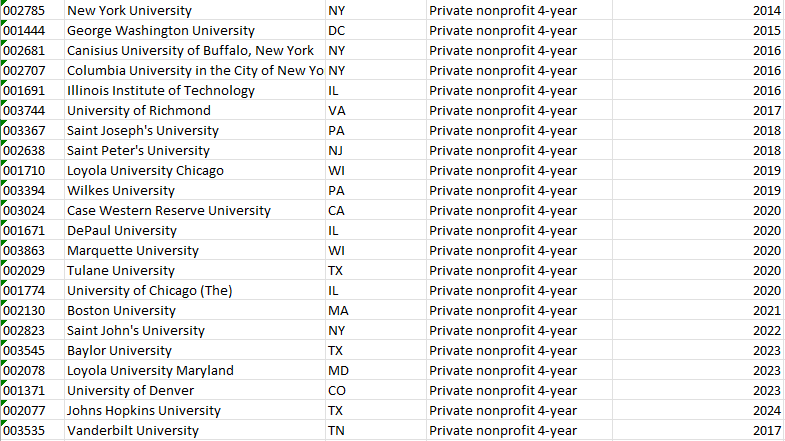
Of course, they didn’t. They closed branch campuses, usually, or closed high school programs that grant college credit, which caused them to show up on closed program lists; they are all very much alive, however. (Blame the quirk of IPEDS UnitID vs OPE ID numbers for the confusion).
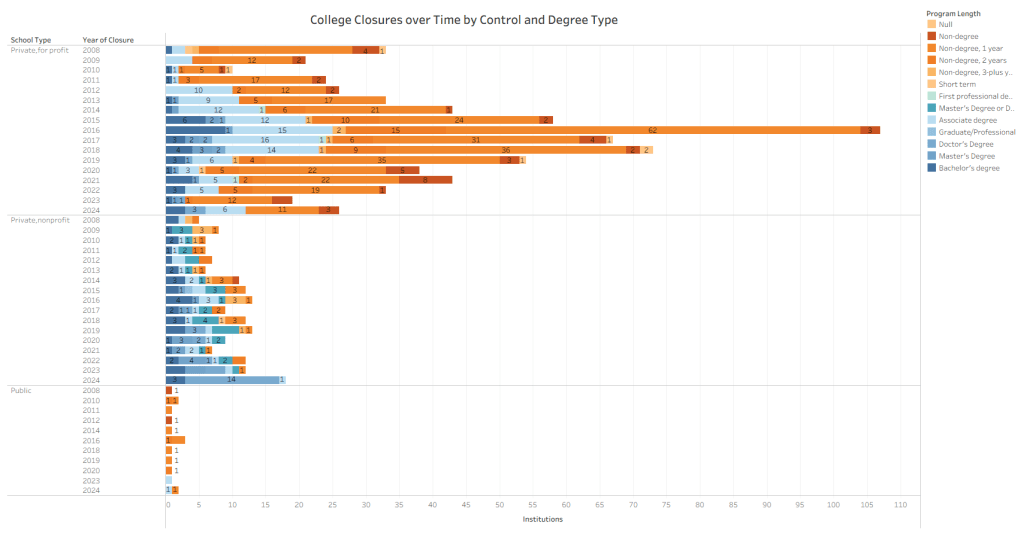
The chart below is a better indicator of actual college closures, downloaded from this Hechinger Report story. Note, however, that the number of public institutions is very low, and the number of private, not-for-profit institutions is also relatively small; and among that latter group, many of them are certificate-granting institutions (orange), rather than degree-granting colleges and universities (blue). The overwhelming majority of closures are among for-profit institutions, at the top.
In other words, businesses. The sandwich store Subway, by comparison, has closed 8,300 stores since 2016.
Click on the charts for a larger view.
This is where I am compelled by experience to say–explicitly–that any college or campus closing has real effects on the faculty, administrators, students, and the people in the neighborhood and city where the college is located, and I am in no way diminishing those effects. Just in case there was any question about what’s coming up.
But let’s make a hypothesis: Businesses (like for-profit colleges) are not what people are really talking about when they discuss “college closures.” What people are mostly concerned about are private, not-for-profit colleges and public colleges and universities. If you don’t like that hypothesis, you can start your own blog or comment below. (For the rest of this post, consider for-profits excluded, in case I neglect to mention it.) Let’s also suppose that the nation’s smallest, less-than-prominent institutions are most vulnerable to the economic threats we all acknowledge.
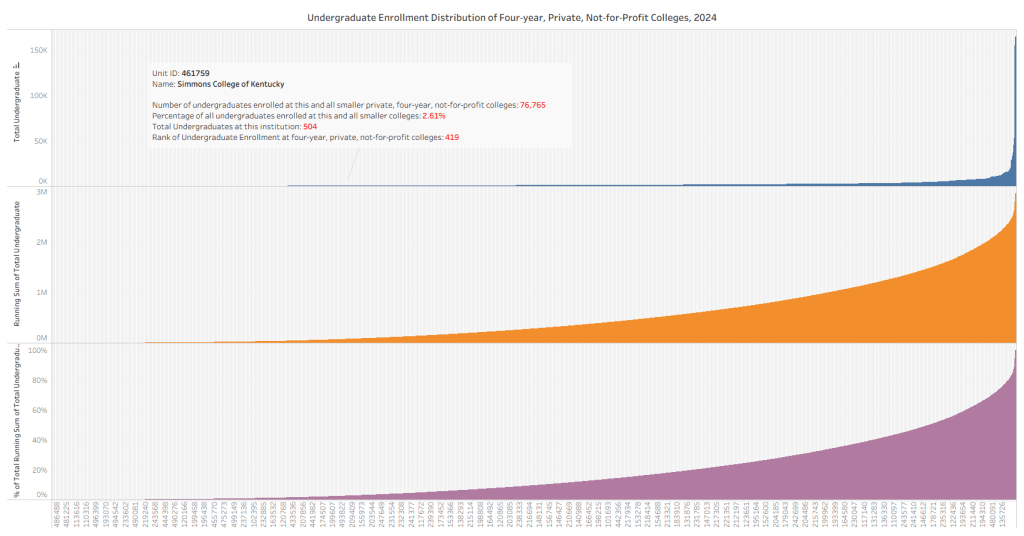
In 2024 IPEDS, there were 1,371 private, four-year, not-for-profit colleges and universities in IPEDS. Let’s say every single one of those colleges with undergraduate enrollment of less than 500 were to close. That would be 418 institutions, enrolling 76,765 students. Simmons College of Kentucky, marked here, would now be the smallest college at 504 students. Fully 418 of those 1,371 colleges (30%) would close.
And if that happened, it would displace 2.61% of all students in private colleges. The closing of Southern New Hampshire University with 164,000 students would have twice the net effect on the higher education industry.
Of course, many more students go to college at public institutions, as you can see here.
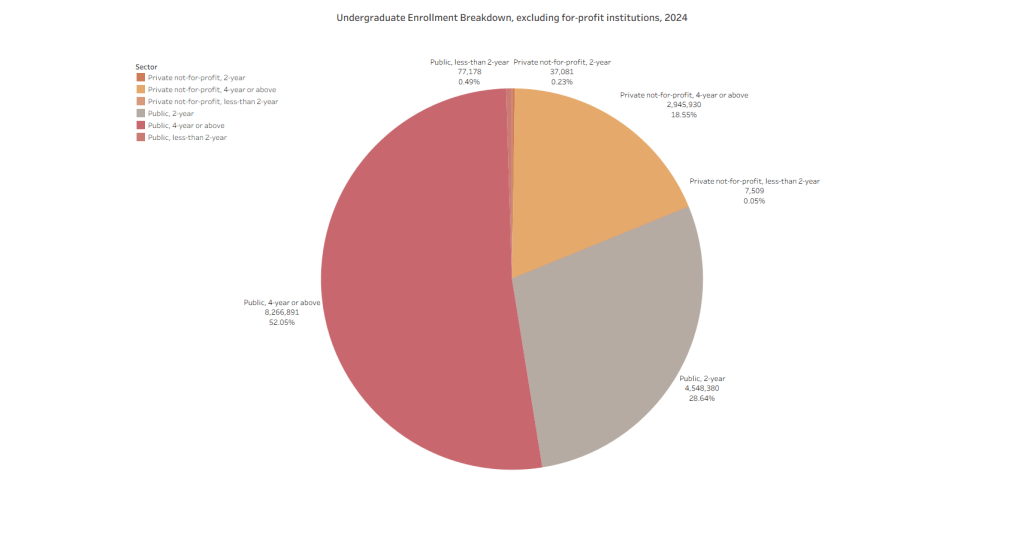
So what if we still closed all the public and private colleges that were smaller than 500 undergraduates? Here’s how that would look:
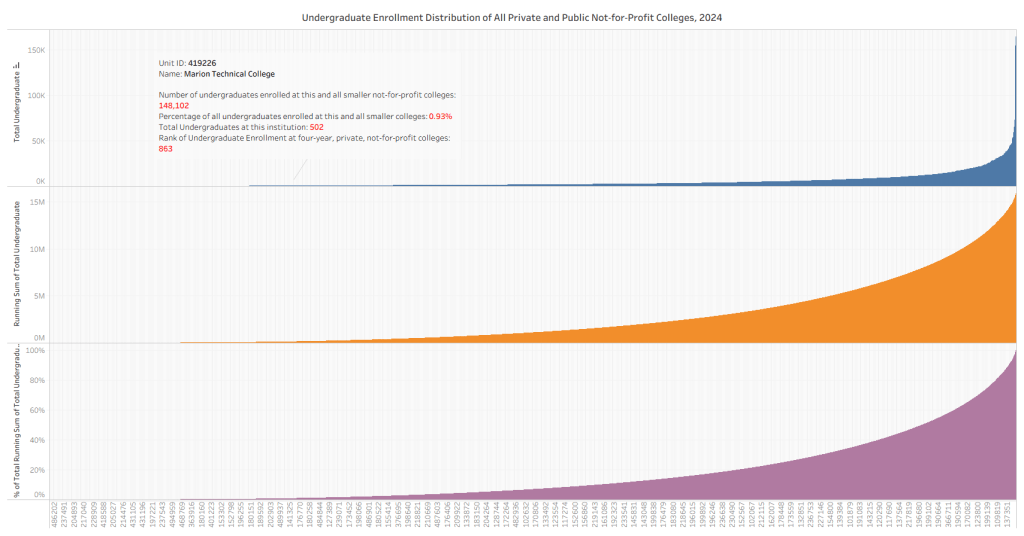
We would close 862 institutions (and Marion Technical College would now be the smallest), and the net effect would be 0.93% of all undergraduates. Again, a very real thing to those affected, but in the scheme of US higher education, not a dramatic effect.
So remember these numbers when you hear about projections of 400 colleges closing over the next five years. Those projections might be too low, because certainly we’ll see closures from colleges with more than 500 students.
All of this is to say, count students, not institutions, and the impact becomes more real, and (only somewhat) easier to take and understand.
Discover more from Enrollment VP
Subscribe to get the latest posts sent to your email.

