
If you follow the news in Higher Education, you are hearing a lot about Demographic Cliffs and Discount Rates and other business angles on what we do. But, as always, you need to be careful about whom you listen to and what you believe.
I saw a great example just this morning in the Chronicle of Higher Education morning news update. The focus is the budget cuts at The University of Oregon, based on (among other things) much lower-than-expected nonresident enrollment. If you have a subscription to the Chronicle or want to give them your email, you can read this very good article there.
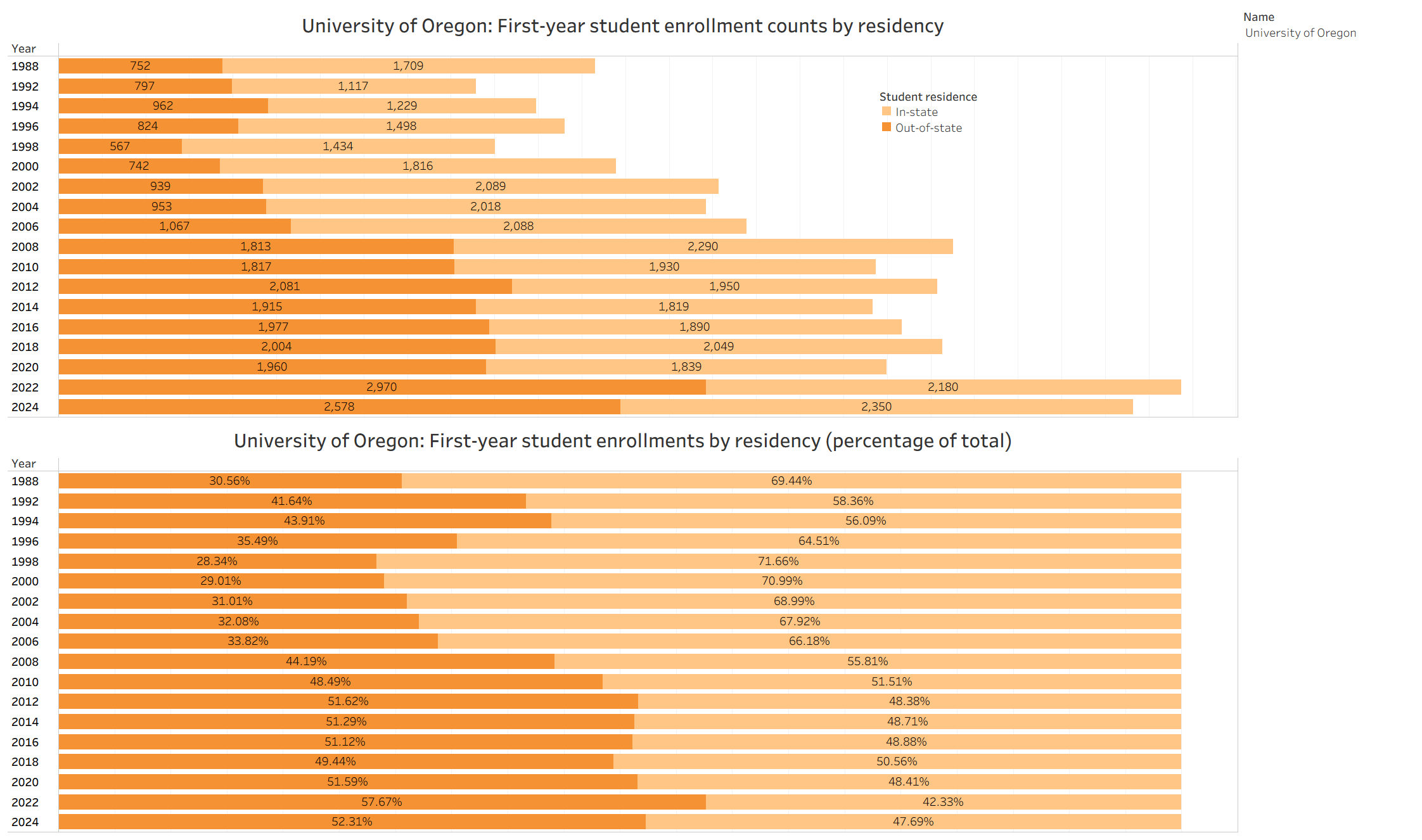
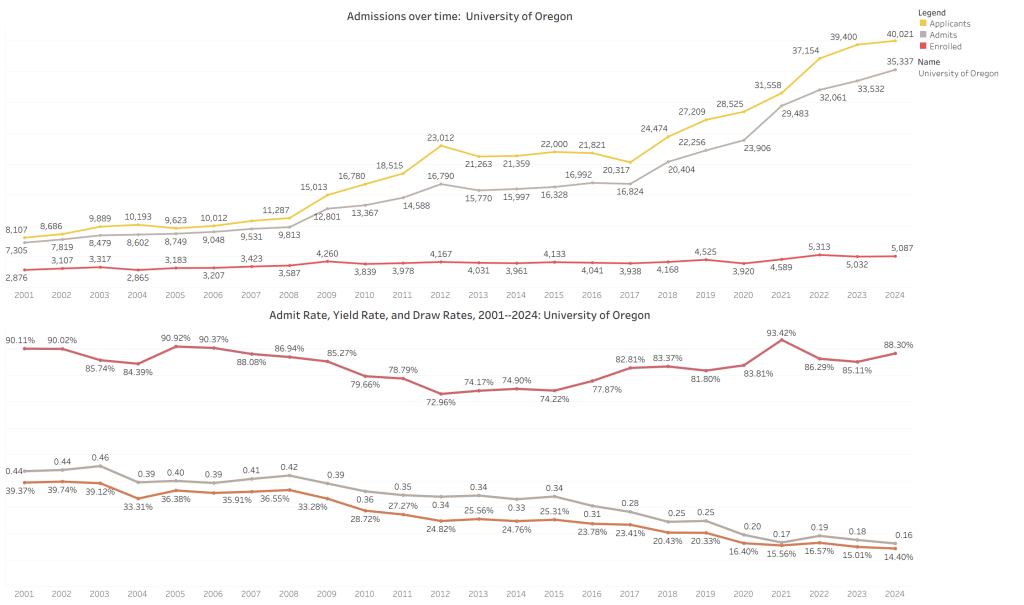
If you’re interested in the long view, you can see here an apparent shift in strategy about 2008, when UO realized one of two things, in all probability: Either that there were more students in California than there were in Oregon, or that there was more cash to be generated from California students than from students inside the state. This appears to have also been about the time capacity issues in the UC System began to be a bigger issue, and state residents in California were getting squeezed out of the flagship institutions. It was a great strategy at the right time.
Click on any image for a larger view.
Here is the data just from California and Oregon, for instance:
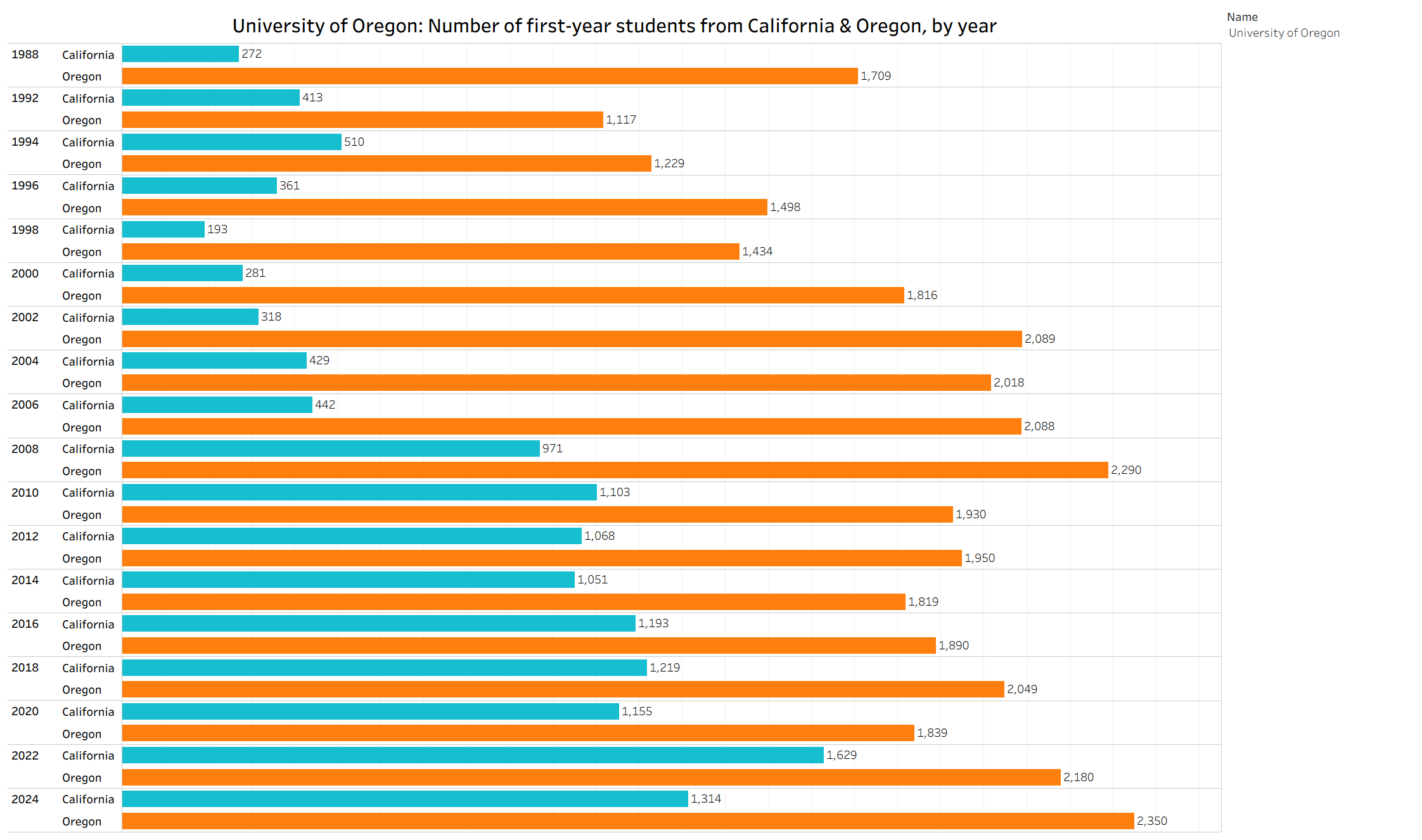
This became such a popular and well-known trend that UO developed the nickname “The University of Northern California” among some observers. But I know–from talking to colleagues at UO–that the irrational exuberance of the 2022 year led to some facile solutions to early budget issues: In order to plug shortfalls and “balance the budget,” the budgeted number of nonresident students was increased fairly late in the cycle for 2024, after the enrollment die had effectively been cast. And, of course, budget issues at UO go back a while, to at least 2019.
(It’s important to say that this method of “balancing the budget” is not uncommon: “Well, just add 20, or 50, or 200 more new students to the assumptions, and magically, Excel says we’re good to go…all in favor….” is a more common occurrence than you might think.)
These problems are not unique to UO, and despite working at a main competitor for six years, from 2019 to 2025, I take no satisfaction from the challenges the Ducks are facing. But what does get me going is stuff like this, from the morning update:
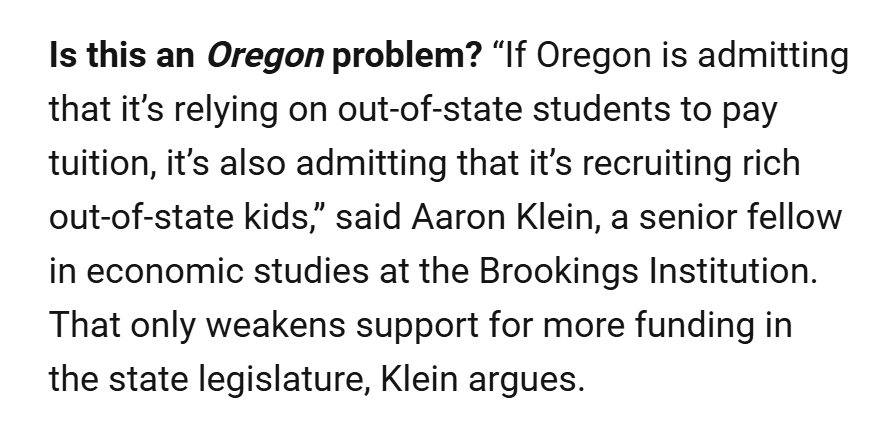
It’s really hard to imagine how someone can get it so wrong. Here’s why.
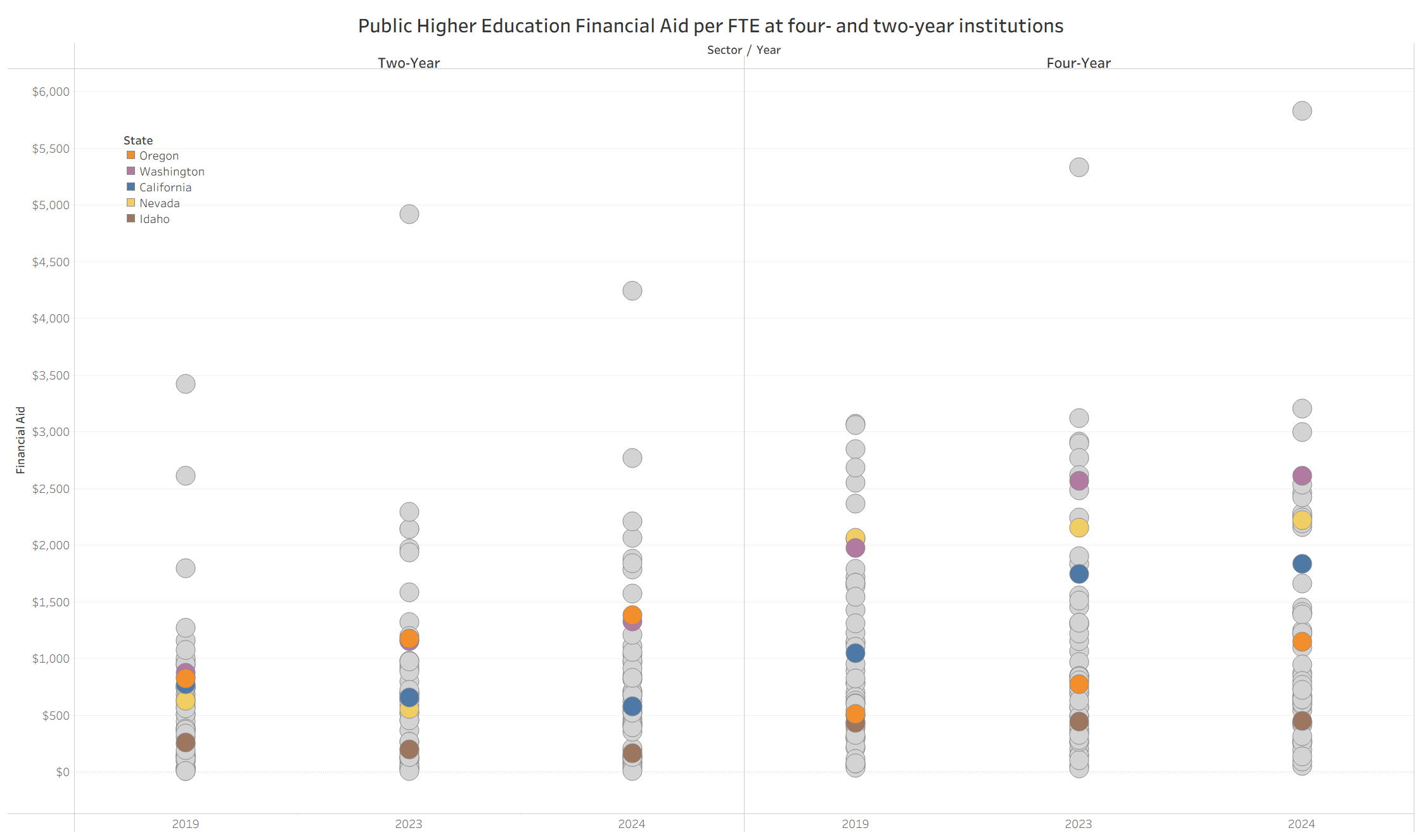
As the article points out, Oregon, despite its reputation for being a highly progressive state, does a pretty crappy job of funding four-year universities, as it has focused primarily on access to two-year institutions in the past several years.
Here is where the states rank on appropriations per FTE, using SHEF/SHEEO data (despite no longer competing with UO, I will continue to always identify Oregon as an orange state on data visualizations. Go Beavs.) Two-year institutions are on the left, and four-year institutions are on the right.
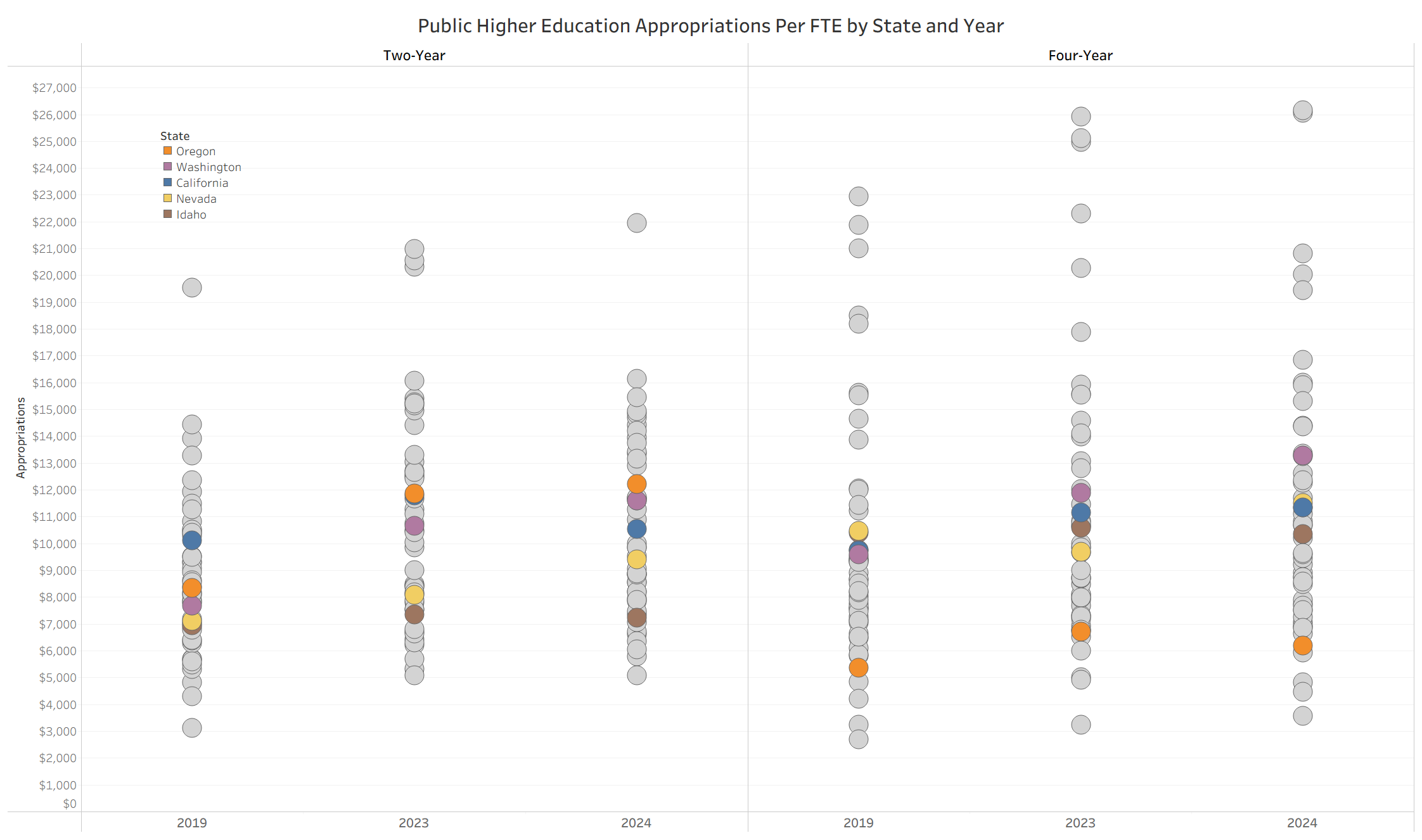
It’s not a matter of the states responding to the universities; it’s a matter of the universities responding to the state. If appropriations continue to be constrained, the university is going to do everything it can to survive. And for the record, this is not an issue of diverting funding to low-income students, as state financial aid is also low compared to other states.
If this were all a zero sum game, of course, the analyst would have a point. If you’re replacing a state resident with a wealthier nonresident, that can be concerning, and many people in California complain about this when the prominent institutions there (who admit under 20% of applicants) enroll more nonresidents. In that case, every enrolling student from outside the borders does potentially displace someone whose parents are paying taxes to support the system.
So let’s look at UO admissions over time to see what’s happening. As you can see, the percentage of applicants offered admission (the red line on the bottom chart) has actually increased over time, and was close to 90% in 2024. While public institutions don’t generally report admit rates broken out by residency, it’s a pretty safe bet to say that UO (like all public institutions in the state) is not denying admission to well-qualified state residents the way a UCLA or Berkeley might be doing.
So, squeezing all it can out of resident enrollment, UO (like lots of other public institutions) looks out-of-state for enrollment. But that brings up another point: Many articles I’ve read assume nonresidents actually pay the sticker price for tuition, and the president even cited a $40,000 net tuition revenue per nonresident student figure, on a roughly $47,000 tuition figure. That seems unlikely, given the UO Scholarship page which suggests much larger scholarships for many nonresident students.

Again, there is no hard data on this, but having seen demand curves and price elasticity functions as part of my daily job for at least the last 20 years makes me fairly certain the actual net amount is much, much less than $40,000.
So, what’s the harm in citing an analyst? And what’s the point of this post?
Your trustees and your state’s education commissioners and your faculty and your administrators outside of EM see this stuff, and read it, and internalize it, and suddenly, everyone (even someone 3,000 miles away who may not have ever set foot on your campus, or who may have never worked on an actual campus) is getting their attention and is now labeled an expert. Sometimes they’re right, of course. Often they are not.
If you’re a VP EM, one of your primary jobs is to manage this information and misinformation, and make what you do and how you do it as transparent as you possibly can. You’re the expert on your campus and your enrollment, and you should never, ever cede that to someone who’s not.
It’s still an uphill battle, but it’s worth fighting for.
Discover more from Enrollment VP
Subscribe to get the latest posts sent to your email.
 Enrollment VP